Followers

Tuesday, September 16, 2025

Trump ends grants to support Indigenous students at the University of Alaska

Financial support for Alaska Native, American Indian, Hawaiian and Pacific Island students at the University of Alaska will end within a year. 

This will impact over 20% of the student body, with 266 identifying as Hawaiian Native or Pacific Islander and 3,254 students as Alaska Native or American Indian out of a total of 19,629 students in the UA system as of Autumn last year. 

The funding will be reallocated, continuing Trump’s commitment to eliminating programs that focus on diversity, equity and inclusion. 

link here 

Monday, September 15, 2025

Indigenous Evacuations in Canada

 First, and short, article on our research looking at Indigenous experiences of evacuations.

Long story short, Indigenous engagement and - where relevant - control and leadership during an evacuation is vital to ensure the safety of Indigenous families. Too often, families are separated and (re)traumatised during an evacuation. With wildfires and flooding predicted to increase in frequency and intensity, empowering Indigenous communities to control their own evacuations is a necessary first step in ensuring an effective, efficient and just evacuation.   


Link here


Tuesday, June 10, 2025

Hunting the 1%'s Doomsday Bunkers in New Zealand


Hadn't seen this before but a very interesting insight into what some (very, very rich) people are thinking and doing as talk of the End Times builds pace...


There's a growing literature on tech-eschatology where 'The Mindset' accepts we are living in the End Times. The biblical prophecies are echoed in the ways that unsustainable industrial capitalism has painted itself into a bleak corner and individuals' with the wealth and inclination frame their lives both as Sovereign and so fragile as to require investment in escape bunkers where they will wait out the apocalypse.

Hard rains' gonna fall.


Friday, May 09, 2025

We aren't all meant to Hunker in the Bunker...

 A constant refrain from environmentalists is that the current economic development approach is unsustainable as perpetual growth is impossible in a world of limited resources. Capitalism is leading humanity into, if not oblivion, then a very dark and frightening future.

I think we are misreading the situation.

First, financial and political elites are decidedly NOT climate deniers, given their strategies play to an acceptance of the end of life as we know it.

What we are witnessing is the shameless scramble for the world’s remaining resources, the deliberate exclusion of those considered undesirable (which seems to be the great majority of citizens), the reduction or elimination of programmes of climate change mitigation and adaptation, and the mocking of any hint of social or environmental justice.

Second, we have proof of concept that humans are not bound by Plant Earth. Science fiction has become science faction. The discovery of Earth-like planets, the regular headlines 'life on Mars', celebrity space travel and so on show that wealthy elites no longer consider themselves constrained by earthly limits and are injecting billions of dollars into space research on the premise that we need ‘options’, yunno, just in case [insert latest apocalyptic scenario]. Planet Earth seems to be a lost cause to many powerful people, and they are voting with their money with the object of voting with their feet.

As Fredric Jameson noted (2003), it is easier to imagine the end of the world than the end of capitalism.

This appalling situation can be understood as a unique confluence of capitalism’s hellbent destructive innovation in the search for profit with the Christian eschatological appetite. Prior to becoming Pope Benedict XVI, Joseph Ratzinger (1988) wrote a challenging text on the history of eschatology, the study of the ‘last things’, often interpreted as ‘the end times’, in which he reminds us that the preaching of Jesus was focused on the imminent end of the world which was not seen as a particularly distant event. Thy Kingdom Come[1]. The ongoing brutality visited upon Gaza present, for some, is the fulfilling of Biblical prophecy. One US Baptist pastor rejoiced in the genocide as “God has allowed us to see the day when His prophetic clock started running again. We are the generation to see the final biblical prophecies come to pass…The King is coming!” (Lavin, 2023).

What has this to do with the ramping up of unsustainable resource extraction?

Indigenous (Potawatomi) scholar Kyle Whyte (2017) describes the ongoing colonial oppression of Indigenous Peoples as an outcome of capitalism and industrialisation, particularly at the hands of the fossil fuels sector. He tags Garret Hardin’s Poverty of the Commons as framing an analysis of rich countries as being like lifeboats surrounded by drowning poor people – a result of deteriorating environmental and economic conditions. There is only so much space on a lifeboat and survivors have an obligation to prise the fingers of the drowning hordes from constrained safety. Is this not the argument of conservatives everywhere (though most volubly in the US) who see ‘hordes’ of immigrants threatening their (energy intensive) lifestyles? Build the wall.

But the creativity of capitalism is inseparable from its self-destruction.

The 2023 centre right/far right government of Aotearoa assumes the country is facing an existential threat of economic oblivion. This fear justifies the dilution or circumvention of standard parliamentary procedures (NZ slipped from 3rd to 4th in Transparency Internationals Corruption Index; Transparency International, 2024) and voters are mocked for their concerns over biodiversity (Mills, 2023) and privatisation (Shaw, 2025) and the stuttering progress on sustainability is poised to be dismantled.

Yet I see this fear sitting within a wider existential fear of a loss of their cultural identity, principally exemplified by a Māori renaissance, many decades in the making, that parallels other social movements of increasing ethnic diversity, non-binary genders and sexual fluidity, and women’s rights (the right to birth control and abortion are under threat in multiple liberal democratic and authoritarian states). Rich white people are losing control, and this is the disaster.


Jameson, F. (2003) ‘Future City’, New Left Review, (21), pp. 65–79.

Lavin, T. (2023) ‘These Evangelicals Are Cheering the Gaza War as the End of the World’, Rolling Stone, 17 November. Available at: https://www.rollingstone.com/politics/political-commentary/gaza-war-evangelical-leaders-cheer-end-world-1234884151/ (Accessed: 8 May 2025).

Mills, L. (2023) Goodbye, minister tells frogs impeding mining | Otago Daily Times Online News. Available at: https://www.odt.co.nz/regions/west-coast/goodbye-minister-tells-frogs-impeding-mining (Accessed: 25 February 2025).

Ratzinger, J. (1988) ‘Introduction: the state of the question’, in Eschatology: Death and Eternal Life (Dogmatic Theology). Washington D.C: The Catholic University of America Press.

Shaw, R. (2025) David Seymour says Kiwis are too squeamish about privatisation – history shows why they lost the appetite, The Conversation. Available at: http://theconversation.com/david-seymour-says-kiwis-are-too-squeamish-about-privatisation-history-shows-why-they-lost-the-appetite-248308 (Accessed: 25 February 2025).

Transparency International (2024) New Zealand’s score slips 2023 Corruption Perceptions Index, now ranked third. Available at: https://www.transparency.org.nz/blog/new-zealands-score-slips-in-latest-corruption-perceptions-index-now-ranked-third (Accessed: 25 February 2025).

Whyte, K. (2017) ‘Way Beyond the Lifeboat: An Indigenous Allegory of Climate Justice’, in D. Munshi et al. (eds) Climate Futures: Reimagining Global Climate Justice. Los Angeles: University of California Press.


[1] Ratzinger sees all subsequent Church history as “a saga of ‘de-eschatologizing” (p. 2).

Thursday, April 10, 2025

Following the flight of the wind wanderers


Nifty vid on a Scion (ex-NZ Forest Research Institute) project I'm supporting. Basically, Aotearoa receives potential pests and diseases from offshore by various pathways including 'airbridges', many of which originate from our friends and generally good neighbours, Australia. 

This MBIE funded project explores warning systems to alert us when the aerial arrival of insects and pathogens is more likely. It began in October 2023 and runs through to 2028. Researchers are looking to fill critical knowledge gaps in atmospheric science and aerial invader biology to understand how organisms survive the journey in extreme atmospheric conditions and model techniques for how airbridges connect Aotearoa New Zealand to other landmasses, and how stuff is deposited on our whenua.

"It’s time to learn how we can strengthen our “biosecurity net” to predict when organisms may arrive and which are more welcome than others."


Key partners are Taranaki Mounga who assist in finding locations for monitoring and also supporting the integration of the science into efforts to protect their mounga. Mana whenua are helping with surveillance and identifying how this research can benefit Taranaki iwi.


Thursday, March 27, 2025

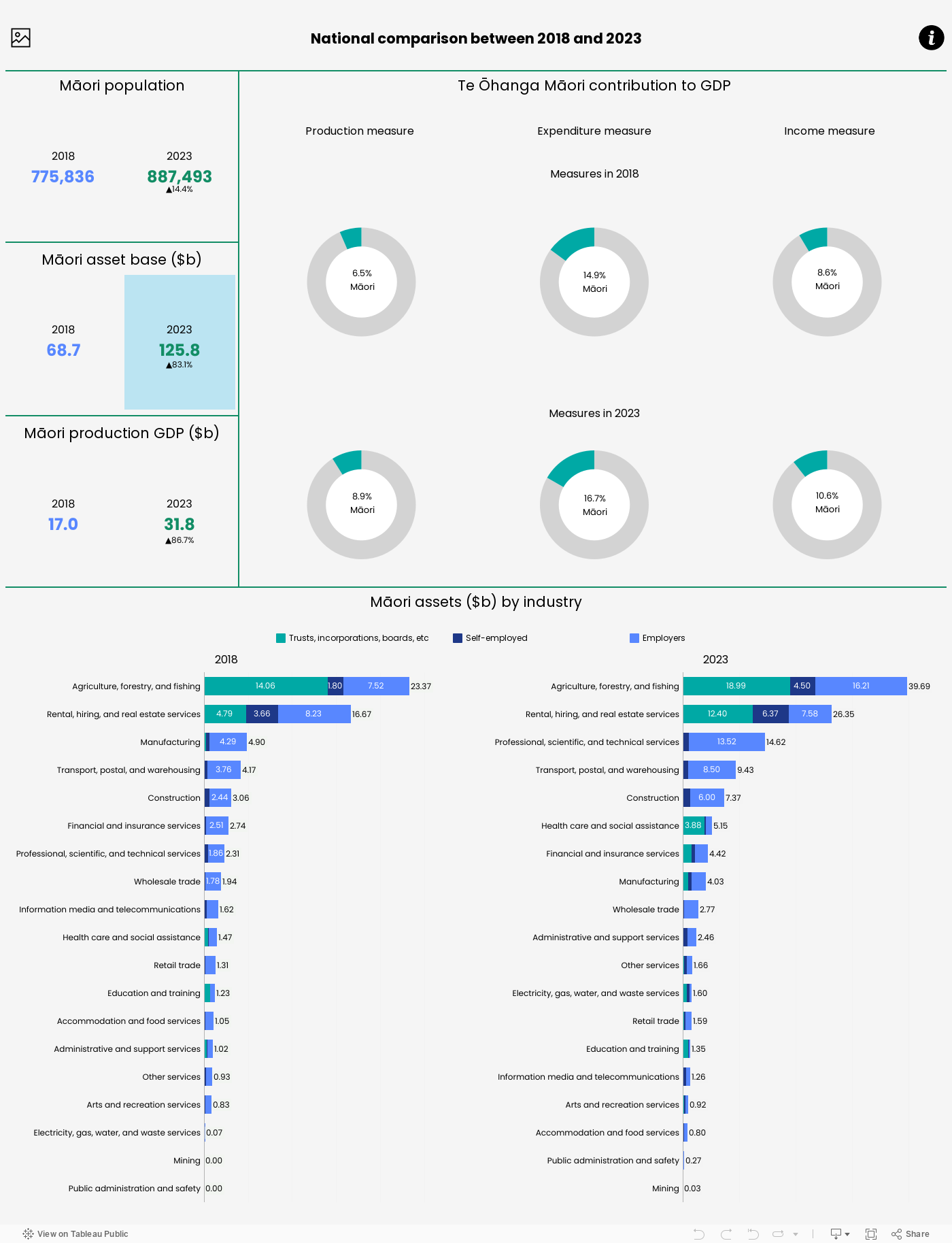
Maori economy update

 I started this blog to post on Maori economy data that was being released by the NZ government. That policy was sparked by Minister Pita Sharples seeking to promote the contribution Maori made to Aotearoa NZ, countering the deficit model that was prevalent. 

Latest measure has this economy up by 83% from 2018 to $125 billion.

Top players, including my own Tuhoe, are listed below (link here):


 Realise that the methodology has changed over time but the growth is impressive. Which begs the question why the ongoing negative socio-economic stats...

Anyway, loads of data to play with if you are that way inclined.

Friday, March 21, 2025

Maori Emergency Management Network: Hono

Hono, a Maori Emergency Management Network, was launched end of last year in Whanganui-a-Tara (Wellington). Established by Hinemoa Katene, Hono's vision is: 

A world where Indigenous wisdom and self-determination drives resilience, protects our people and the environment, and inspires global solidarity in the face of disaster. 

Essentially we seek agency for Maori in managing emergencies and disasters which - as most people seem to accept now - are increasing in frequency and intensity. Much of this new disaster space is with severe weather, as Aotearoa exprienced in the early part of 2023. The impacts are outlined in a key report (chaird by Sir Jerry Mateparae, link here). 


Tragically, shorter after this launch, Professor David Johnston (2nd from right, front row) died, leaving a son, Josh, and wife, Caroline. He also left a huge hole in the Joint Centre for Disaster Research (JCDR) based on the Massey Campus, Wellington.  

David's legacy is embodied in the people and places he's had a positive impact on with his work and the work he's supported through colleagues and students.

Anyway, watch this space! 

Thursday, March 20, 2025

DRR Dancing in the Dark...

Heads up from Professor of Disaster Economics, Ilan Noy (Victoria University, Wellington). Recent withdrawl of funding for many US databases has emphasised the lack of NZ investment into, inter alia, disaster loss data collection. 

Ilan (we've met, so I'll use his first name although still a bit cheeky of me...) argues in his patient, cogent manner with barely a hint of the obvious frustration he must be feeling that if we do not make this investment into very basic data collection then we are left, if not exactly blind, certainly feeling our way in the gloom in efforts to plan for the future. 

"Without understanding the magnitude of the problem, our ability to prevent damage or recover from extreme weather is diminished. It is indeed difficult to manage what we don’t measure."

This follows on from revelations last year that several strategies to build a data infrastructure for better emergency management have been scrapped or drastically reduced in scope and scale. 

As Phil Pennington (RNS) reported June last year, the brutal public sector cuts left a half-built emergency coordination system, despite reports on Cyclone Gabrielle reeiterating the Aotearoa desparately needs better data infrastructure as people were let down by the inability to quickly share the same information across multiple hardpressed responders.

Land Information NZ (LINZ) had actually built a platform of maps and risks but had to drop a project that would actually make it easier share access to this in a disaster. The project began in 2021 "but was never properly funded from the start".
 
So more short-termism from the current NZ government.

Prof Noy (back to formalities) gives this graph to show the range of dollar totals given for damages in the severe weather of early 2023: 


I know that NZ scientists have often drawn on overseas data sources, especially from the US (e.g., NASA) to plug the (many) gaps in our own data collection. As NZ also downsizes its commitment to science funding, we can expect even less insight into our rapisly changing world.


Hard rains gonna fall. 


Tuesday, August 13, 2024

Aotearoa New Zealand GMO Regs to be updated

Continuing the rush of legislative changes in Aotearoa, the Minister for Science released Cabinet papers on GMO regulations. 

Link here 

Māori consultation highlighted the role of wāhine Māori in protecting taonga species, and how the Nagoya Protocols would empower Māori in this space. 

Came to nought.

MBIE has released a vid explainer:


A single regulator is to be established, with technical advice and a Māori advisory committee (MAC). The decision-making process is seen as a technical and scientific process with socio-cultural concerns irrelevant.

The Pant Varieties Act 2022 is offered as a model for Māori engagement; Section 63 has is worth perusing:

Assessment where kaitiaki relationship asserted

In a case where an iwi, hapū, individual of Māori descent, or Māori entity asserts that they have a kaitiaki relationship with the plant species that is the subject of a PVR application, the Māori Plant Varieties Committee must also consider—

(a) whether that person, iwi, hapū, or other entity has demonstrated their kaitiaki relationship with the relevant plant variety and associated mātauranga Māori:

(b) if a kaitiaki relationship has been demonstrated,—

(i) the kaitiaki’s assessment of the effect of a grant of the PVR on their relationship; and

(ii) any agreement to mitigate adverse effects reached between the breeder and the kaitiaki; and  

(iii) whether there is any evidence that the parties have not acted in good faith during their engagement (if any).

Friday, July 12, 2024

Keep on Truckin'

 I'm what some call a 'qual', relying on qualitative methodologies, but I do love a good spreadsheet.

Here's the ANZ's 'Truckometer', a simply metric that basically counts trucks, heavt trucks in the graph below. Simple and instinctual no? 


What we see is traffice tracking down wehich is a lead indicator for GDP.

Heavy traffic data (mostly trucks) tends to provide a good steer on production GDP in real time, as it captures both goods production (including agriculture) and freight associated with both wholesale and retail trade. The heavy traffic index slumped markedly in June, with the 5.2% fall unprecedented outside of lockdowns.

Hard rain's gonna fall...


Thursday, June 08, 2023

Bioprotection Aotearoa

Bioprotection Aotearoa is one of those research centres in Aotearoa NZ reframing how it engages with Māori. The short clip below gives an outline of their pitch. What is important to note is that Māori are no longer willing to be used for decoration; the old 'dial a powhiri' approach is exactly that, old!


Saturday, May 20, 2023

Long time, no see

It's been rough and rocky travelin'But I'm finally standin' upright on the groundAfter takin' several readingsI'm surprised to find my mind's still fairly sound


So sung the great American philosopher, Mr. W. Nelson (born 1933) who according to many t-shirts said that if marijuana was a gateway drug, it better hurry up. 

Anyway, I'm catching up but start by assuming there's still lots going on with the Maori Economy, however one defines and understands that. Going to The Google, I see MFAT provides a short PDF that draws on a CHapman Tripp report valuing the, what, sector? at $50 billion. The research dates back to 2017 - another time in more ways than one - but will serve as shorthand:


Given the changes likely to come to forestry following the slash controversy  and although a recession may now be averted (ironically through extra spending on the Cyclone recovery), Maori employment is - as always - higher than Pakeha and predicted to edge up over th enext year. 

Watch this space...


Friday, November 05, 2021

Indigenous Identity Fraud: Too much weights reprise

The recent exposure of Dr. Carrie Bourassa as having Russian-Czech-Polish ancestry and not the Metis-Tlingit-Anishinaabe genealogy she has persistently claimed for two decades has thrown Indigenous academia into turmoil.


This latest case of identity fraud in academia comes close to home for me. The University of Saskatchewan has been my professional residence since 2017. Bourassa was much feted by the University, showered with awards and funding, and assumed a level of seniority, power and influence over significant federal investment in Indigenous health research. (Key in this is the $100m plus for the Network Environments for Indigenous Health Research; I am a Co-PI in the Saskatchewan NEIHR and executive director of the NEIHR National Coordinating Centre). 

There have been accusations of other fraudsters at other Canadian universities, notably Queens. But Bourassa's case has torched a fire of anger and grief that caught the institution flat footed. Fanned by social media - as is the modern way - people leapt to deride universities processes that have seen Indigenous positions given to non-Indigenous people. Many of these have simply applied for a position that did not specifically require an Indigenous appointment; others, like Bourassa, have fabricated genealogies and experiences that pass into cliché and perverse one upmanship of Indigenous trauma.

Dean of the Faculty of Native Studies at the University of Alberta. Professor Chris Anderson, has penned a thoughtful and insightful op-ed outlining the issues and ways forward. He identifies two characteristics to Indigenous identity claims in academia: 

"First, they are based primarily on self-identification that sits somewhere on a spectrum from complete dishonesty, to distant archival ancestors, to the family lore of a dark-skinned or high cheek-boned great/grandparent. Second, they involve no ongoing extended familial connection to an Indigenous community."      

The Bourassa Incident will reverberate through academia for some time yet. But the worse impacts will be on the very Indigenous communities, including Indigenous grad students, that Bourassa aped and in doing so, mocked. I met with Carrie several times, including pre-covid, when I could observe her up close and in vivo or should that be in vitro. The overwhelming impression was one of performance, an OTT display of "Indiginess". Draped in a Metis sash, big earrings, often tremulously holding an eagle feather, Carrie seemed as if she was play-acting, a life where everyday was Halloween. Dr. Tracy Bear eviscerates this dress-up as that of a "life-sucking vampire", dismissing accusations that it is a witch hunt as witches never enjoyed the power or wealth of Bourassa. 


There's a lot of healing to be done. I do expect efforts to "follow the money" and shine some sunshine on what are too often opaque processes of appointment and funding. And of course we must have a real engagement with Indigenous communities, in Saskatchewan, across the country called Canada, and indeed the international Indigenous world.

Some readings:
Tuck and Yang (2012): Decolonization is not a metaphor.

Also Albert Memmi on scientific racism. 

Monday, October 04, 2021

Too much weights...


Jake: Gee, where did you get those muscles from? Bro, you've been lifting those weights, huh?

Thug: …

Jake: What, you've done lag? Am I right?

Thug: You want to fuck with me?

Jake beats thug

Jake: You should learn to pay your respects. In case you want to know, it's Jake... Jake the Muss.

Cheers

Jake: I was right... too much weights, not enough speed work. Useless prick.
                                                                                  
                                                                                                                          Once Were Warriors, 1994


Mulvaney: There's only one sure thing in this life, Blondini, and that's doubt. I think.

                                                                                                                          Goodbye Pork Pie, 1981

No Natural Treasury: NZ coffer-keeper still behind the times

 Back in Aotearoa after several years away in Turtle Island, I am somewhat disturbed to find the NZ Treasury - now labelled 'Te Tai Ohanga - using the term 'natural disaster'.

This framing of disasters as exogenous to society was kicked to the sidelines in the 2015 UNDRR Sendai Framework, with disaster risks now recognised is embedded in development processes. 

The report is just published, I'll pick through it over the next week and see in what ways Aotearoa NZ is manifesting the much fabled resilience, and in particular how Māori are positioned. (The demographic projection for Māori, 21% of the total population by 2043, and 11% of the over 6.)

The prediction is that...

"Natural disaster events [sic] are likely to become more common and add economic and fiscal costs on top of the costs of more gradual temperature and sea level changes. Policy action today on adaptation could reduce some of those costs in the future."


Well, yes. 


As an example, the report provides this table of impacts from climate change.


The Climate Change Minister notes Te Arawa's climate change strategy provides some ways forward in this troubled future.

Te Urunga o Kea - Te Arawa Climate Change Working Group 


For those wanting a bit of the history of Indigenous Peoples and disaster risk reduction, John Scott and I wrote about this in a paper published a couple of years ago in the International Indigenous Policy Journal

link

Tuesday, January 14, 2020

Australian Indigenous community DRR

 Much online discussion about the Australian bushfires – outpouring of sympathy etc. – and within that a growing role for First Australian knowledges on, well, survival.
And lest we lose sight of the contributions from Australian academics, let me remind colleagues and peers of a prescient paper by Dr. Heidi Ellemor who in 2005 published a work arguing for Indigenous voices to be heard in the strategies and tactics of environmental management in their territories (Ellemor, 2005). Dr. Ellemor’s work builds on that of John Campbell (J Campbell, 2006; John Campbell, 2010) who flipped ascriptions of Pacific vulnerability (a colonial hangover) to one of resilience.

In the time of takeaways, I cut and paste this from the paper:
“The recognition and inclusion of indigenous peoples’ knowledge can help to destabilise the hegemonic status that certain understandings or preferred readings of a situation have gained.”

Page four for the pedantic.
I’m sure back in the early days of the 1992 Mabo Decision, Australians of all mobs could expect to see a more environmentally just and survivable landscape, and that even the most diehard Ozzie racist (and they can be a frightening beast) would accept a collaboration (alignment? acceptance? trust?!) in any knowledge that would help the very survival of what you claim and cherish is at mortal risk?

Dr. Ellemor articulated all this very well, a generation of Australians (and geography grads) ago.
I follow Aussie politics more than most not from the Lucky Country, and for two reasons: 1) the remarkable endurance of myriad Indigenous communities (see the Uluru policy change); and 2) if the metaphor of ‘frontline’ is to mean anything in this instance, then Aussies are in the trenches again.
Now to Kiwi’s, the imagery of brutal trench warfare is closely linked to our Aussie mates and neighbours; I’m sure the ‘ANZAC spirit’ has been invoked. And with the orange haze over Aotearoa, and people goggling PM25, we realize that if we’re not in the trenches just yet, we can smell the carnage from the assembly point in godszone…

Bibliography

Barnett, J. (2017). The dilemmas of normalising losses from climate change: Towards hope for Pacific atoll countries. Asia Pacific Viewpoint, 58(1), 3-13. Retrieved from https://onlinelibrary.wiley.com/doi/abs/10.1111/apv.12153. doi:10.1111/apv.12153
Barnett, J., Lambert, S., & Fry, I. (2008). The hazards of indicators: insights from the the Environmental Vulnerability Index. Annals of the Association of American Geographers, 98(1), 102-119.
Campbell, J. (2006). Traditional disaster reduction in Pacific Island Communities. Retrieved from Lower Hutt:
Campbell, J. (2010). An overview of natural hazard planning in the Pacific Island region. Australasian Journal of Disaster and Trauma Studies, 2010-1. Retrieved from http://www.massey.ac.nz/~trauma/issues/2010-1/campbell.htm.
Ellemor, H. (2005). Reconsidering emergency management and indigenous communities in Australia. Global Environmental Change Part B: Environmental Hazards, 6(1), 1-7. Retrieved from http://www.sciencedirect.com/science/article/pii/S1464286704000294. doi:http://dx.doi.org/10.1016/j.hazards.2004.08.001
Lambert, S. (2014a). Indigenous Peoples and urban disaster: Māori responses to the 2010-12 Christchurch earthquakes. Australasian Journal of Disaster and Trauma Studies, 18(1), 39-48. Retrieved from http://www.massey.ac.nz/~trauma/issues/2014-1/AJDTS_18-1_Lambert.pdf. doi:http://www.massey.ac.nz/~trauma/issues/2014-1/AJDTS_18-1_Lambert.pdf
Lambert, S. (2014b). Maori and the Christchurch earthquakes: the interplay between Indigenous endurance and resilience through a natural disaster. MAI Journal, 3(2), 165-180. Retrieved from http://www.journal.mai.ac.nz/sites/default/files/MAI_Jrnl_V3_iss2_Lambert.pdf.

Wednesday, January 08, 2020

The climate crisis is also a biodiversity crisis

Important message from Dr. Andrea Byrom, Director of the Biological Heritage National Science Challenge who has been provoked into a forthright contribution to the NZ Sciblogs site.

International media outlets are full of gut-wrenching images of burned koalas, video footage of fleeing kangaroos, and firefighters sharing water with wildlife. Judging by the public outpouring of emotion (and donations) in response, intuitively we know something is very, very wrong. We care about biodiversity, and we care a lot. Indeed, we know that people experience grief in relation to biodiversity loss.

Among other points Dr. Byrom raises is this:

I’ve been surprised and disappointed at the scarcity of Indigenous voices in this crisis, at least in mainstream media. As Lorena Allam eloquently points out, Indigenous people in Australia have been connected to the land for tens of thousands of years, and they are watching in anguish as their sacred places go up in smoke. Perhaps Indigenous people can teach us a lot about disaster risk reduction, whether in New Zealand, Australia, or anywhere. That’s not to say that we should revert solely to traditional ways – these fires are unprecedented in their intensity and scale and landscapes are different now – but there is something to be said for listening to the voices of those who have deep connections with the land and its plants and animals, and working respectfully together to come up with contemporary solutions in the apocalyptic world we all find ourselves in.


Now if anyone knows anything about Aussies, they don't lack for confidence. Or they haven't until now. But I do sense a change in how Australia sees itself, both at home and in the world. I think they have lost confidence in themselves, and in their ability to manage their environment.

In the discussion on ecological tipping points we may now be witnessing a tipping point in political action down under.


link to the full blog post.

Monday, January 06, 2020

Post-disaster elections: will the Australian wildfires lead to a paradigm shift in Australian politics?


Spare a thought for our Indigenous brothers and sisters amidst the political storm raging around the wildfire response – or lack thereof – by the Australian government, personalized around the (in)actions of Prime Minister Scott Morrison.

Remarkable footage of Morrison forcing a young, distressed, woman to shake his hand, and being snubbed by a firefighter, has predictably gone viral.

But governments are not always punished in an election for actual or perceived ineffectiveness in the face of a disaster. President George W. Bush survived Katrina. NZ PM John Key survived the Christchurch earthquakes (his party’s position in the munted city improved in the next election, although anecdotally many opposition supporters may have been forced by their housing situation to relocate to other electorates).

So, what does the research say?

I did a quick Google Scholar search and pulled up some stuff.

First, a study published over 50 years ago by Abney and Hill (1966) made some interesting observations. Political scientists have traditionally assumed that political behavior is somewhat determined by their physical environment. We should not, for example, “expect a homogeneous political culture in a country sharply divided by mountains.” They go on to say that disasters have historically been considered ‘bad omens’ for sitting governments but note little empirical research on this: “political activity seems more determined by social environment than physical.” However, “such catastrophes place great stress upon the social framework and thus test the adaptive capabilities of the political system.”

Bien entendu. Since then there have been a number of studies. Summaries of just a few…

Olson and Gawronski (2010) give a very useful overview of the issues. They ask “Why is it that some authorities, governments, administrations, and even entire regimes emerge from disasters more popular and politically stronger, while most appear to emerge less popular and politically weaker, sometimes fatally so?” They argue that the “often problematic political consequences” of a disaster can be seen as ‘‘Maslowian Shocks’’ (yes, that Maslow who drew in Native American philosophy for this hierarchy of needs). A disaster rips off the scab of governance (“strong revelatory components” as they put it) as the voting public analyze government performance along six dimensions: capability, competence, compassion, correctness, credibility, and anticipation.

Bodet, Thomas, and Tessier (2016) found support for the incumbent Calgary mayor increased after the devastating 2013 floods, albeit at a lower rate in those areas of residential flooding. However, they acknowledged flooded areas differed “systematically” from those areas not flooded “in ways key to the election outcome” (p.85): “When analyzed more conservatively, results show that the flood had no effect on incumbent support or voter turnout.”

Arceneaux and Stein (2006) looked at a Houston election (November) that followed their (June) floods of 2001. Voters did punish the incumbent mayor for the flood if they believed he/the city was responsible for flood prep. This expectation of responsibility was shaped by whether a voter’s neighborhood had been hit by flood waters, and their knowledge of local politics. Sainz-Santamaria and Anderson (2013) examined U.S. disaster preparedness spending between 1985 and 2008 and found increased spending in competitive counties. They advise caution in demanding increased DRR spending as the dollars may be put to electoral ends instead of public safety.

The literature seems to be dominated by US case studies. Vanderleeuw, Liu, and Williams (2008) provide a very interesting analysis of New Orleans mayoralty election, post-Katrina (a more reasonable scale of analysis than the race for president (pun intended…). They describe a 15.8% decline in registered African-American voters and a decline of white registered voters of only 5.1%. So, while a black mayor was returned, “whites clearly were in a better position than they had been to challenge black domination in New Orleans politics.”

(Strange language when taken out of context, so please go to the original paper if you wanna argue, and take it up with the authors. I’m just cutting and pasting…)

From the US again, Reeves (2011) identified a relationship between a state’s ‘electoral competitiveness’ and the likelihood and number of presidential disaster declarations. Reeves argues that “presidents use unilateral powers for particularistic aims to gain electoral support.” His findings are based on data drawn from 1981 to 2004, with this relationship existing since the 1988 Stafford Act which expanded presidents powers in declaring a disaster. (The Stafford Act also has implications for Native Americans on reserve. More on that another time). Reeves also argues the use of presidential powers in these events do have the intended electoral benefits: voters will reward presidents for declaring a disaster in their state, more than a one point increase in support.

But what about Australia?

MacLean (2016) in one of the more entertaining papers I have read, hypothesizes the processes and transition of governmental power in a Zombie apocalypse. He argues that, at least in the initial stages, a zombie apocalypse will see coordinated emergency management from the three spheres of Australian government. But as the zombies spread across Australia, he predicts “that both the rule of law and effective communication networks will break down”. In this situation, the Commonwealth government will struggle to “project its power” and resistance will default down to the “effective use of people and resources” at the State and then regional or local government levels. And like any B movie, “[i]n the worst-case scenario, all the current recognised forms of government may fail and survival will depend on new polities created out of desperate need.”

Cold comfort indeed.

In answer the question, ‘Will the wildfires lead to a change of government In Australia?’ I’d have to kick for touch and say maybe. The next election will undoubtedly feature climate change, and many new leaders will arise, as we have seen in NZ through the Green Party. I do think PM Morrison is on shaky ground and whether he survives to lead his party into the next election is another matter, and down to the seething mass of jealousies and aspirations within his own party. I like the six dimensions provided by Olsen and Gawronski: capability, competence, compassion, correctness, credibility, and anticipation. From a distance, I’d rate the Australian government as C+, C-, C-, B-, D, and D respectively.

There's very few Indigenous voices to be heard in all this. 

Time to break out the Mad Max memes?

References

Abney, F. G., & Hill, L. B. (1966). Natural Disasters as a Political Variable: The Effect of a Hurricane on an Urban Election. American Political Science Review, 60(4), 974-981. Retrieved from https://www.cambridge.org/core/article/natural-disasters-as-a-political-variable-the-effect-of-a-hurricane-on-an-urban-election/4479BA7CDBAD24786136A3869F606E28. doi:10.2307/1953770
Arceneaux, K., & Stein, R. M. (2006). Who Is Held Responsible When Disaster Strikes? the Attribution of Responsibility for a Natural Disaster in an Urban Election. Journal of Urban Affairs, 28(1), 43-53. Retrieved from https://doi.org/10.1111/j.0735-2166.2006.00258.x. doi:10.1111/j.0735-2166.2006.00258.x
Bodet, M. A., Thomas, M., & Tessier, C. (2016). Come hell or high water: An investigation of the effects of a natural disaster on a local election. Electoral Studies, 43, 85-94. Retrieved from http://www.sciencedirect.com/science/article/pii/S026137941630213X. doi:https://doi.org/10.1016/j.electstud.2016.06.003
MacLean, R. (2016). Unnatural Disasters: Emergency Management in a Time of Zombies Part I: Refereed Articles. Canberra Law Review(1), 47-62. Retrieved from https://heinonline.org/HOL/P?h=hein.journals/canbera14&i=47.
Olson, R. S., & Gawronski, V. T. (2010). From Disaster Event to Political Crisis: A “5C+A” Framework for Analysis. International Studies Perspectives, 11(3), 205-221. Retrieved from https://doi.org/10.1111/j.1528-3585.2010.00404.x. doi:10.1111/j.1528-3585.2010.00404.x
Sainz-Santamaria, J., & Anderson, S. E. (2013). The Electoral Politics of Disaster Preparedness. Risk, Hazards & Crisis in Public Policy, 4(4), 234-249. Retrieved from https://onlinelibrary.wiley.com/doi/abs/10.1002/rhc3.12044. doi:10.1002/rhc3.12044
Vanderleeuw, J., Liu, B., & Williams, E. (2008). The 2006 New Orleans Mayoral Election: The Political Ramifications of a Large-Scale Natural Disaster. PS: Political Science & Politics, 41(4), 795-801. Retrieved from https://www.cambridge.org/core/article/2006-new-orleans-mayoral-election-the-political-ramifications-of-a-largescale-natural-disaster/8BA8FBF1A33A5F80A6E7C1B3B74E5AF4. doi:10.1017/S1049096508081018


Simon Lambert

Create Your Badge